
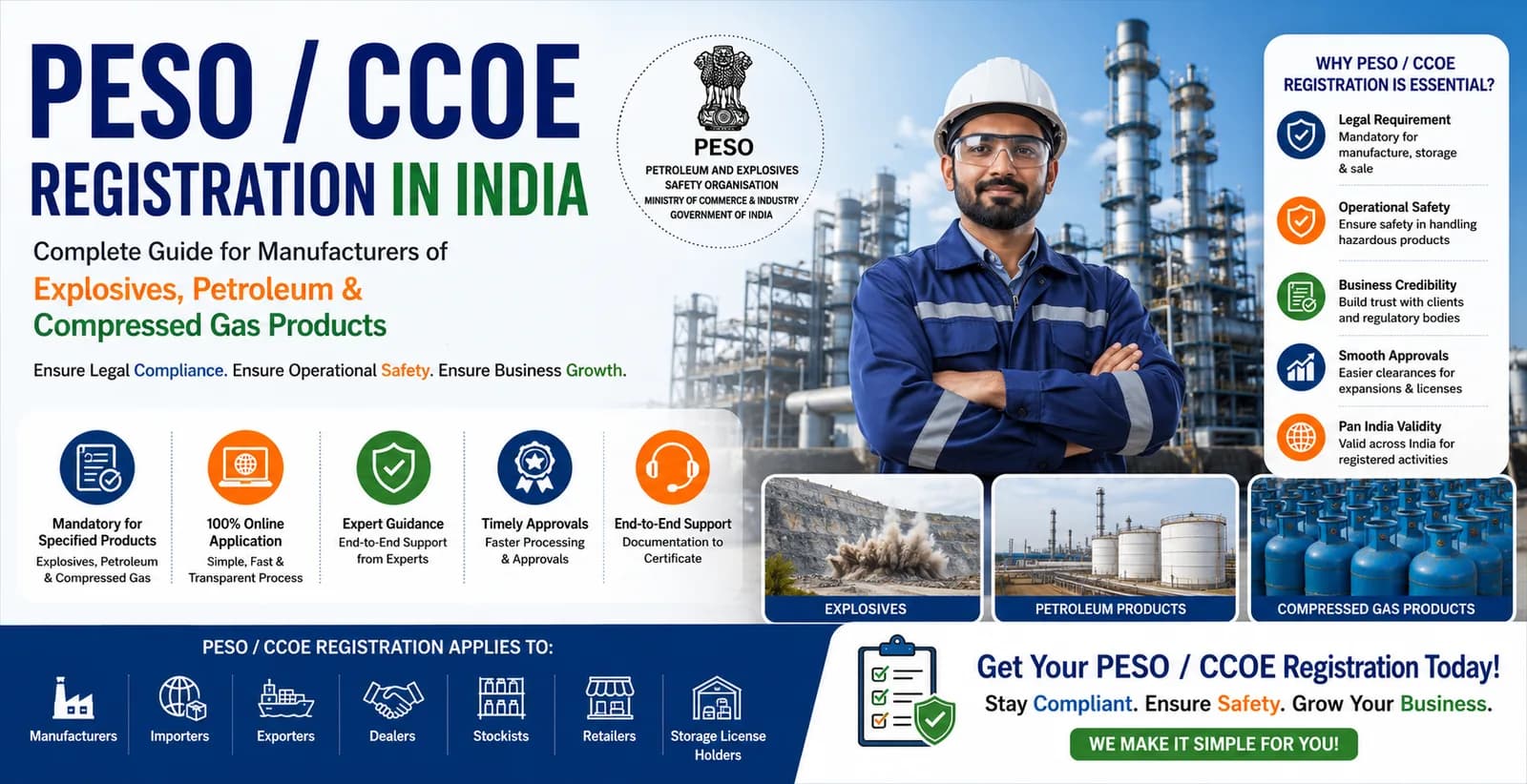
PESO / CCOE Registration in India — Complete Guide for Manufacturers of Explosives, Petroleum & Compressed Gas Products
If your business involves the manufacture, import, storage, transport, or sale of explosives, petroleum products, compressed gases, or pressure vessels in India, PESO Registration — issued by the Chief Controller of Explosives (CCOE) under the Petroleum and Explosives Safety Organisation — is the mandatory regulatory approval that governs your operations.
PESO is India's apex technical authority for safety in the storage, handling, and use of petroleum, explosives, and compressed gases. Operating under the Ministry of Commerce and Industry, PESO administers the Explosives Act, 1884, the Petroleum Act, 1934, and the Static and Mobile Pressure Vessels (Unfired) Rules to ensure the safe handling of hazardous materials across India's industrial, commercial, and consumer sectors.
At Ornate Quality Services, we help manufacturers, importers, and businesses obtain PESO / CCOE Registration for a wide range of regulated product categories — from LPG cylinders and compressed gas containers to industrial explosives and petroleum storage facilities. This guide explains everything you need to know about PESO Registration — what it is, who needs it, how the process works, and how to stay compliant.
Manufacturing or importing products that require PESO approval? Contact our team for a free consultation and get a clear regulatory roadmap for your product.
What is PESO / CCOE Registration?
PESO — the Petroleum and Explosives Safety Organisation — is the government body responsible for the safety regulation of petroleum, explosives, and compressed gases in India. The Chief Controller of Explosives (CCOE) heads PESO and is the statutory authority for issuing licences, approvals, and registrations under India's explosives and petroleum safety legislation.
PESO Registration — also referred to as CCOE Approval or PESO Licence — is the mandatory authorisation issued by PESO for the manufacture, import, storage, transport, and use of regulated hazardous materials and equipment. Products that fall under PESO's regulatory scope cannot be legally manufactured, imported, sold, or used in India without valid PESO approval.
PESO operates under three primary pieces of legislation: the Explosives Act, 1884 (covering explosives and blasting materials), the Petroleum Act, 1934 (covering petroleum storage and handling), and the Gas Cylinders Rules, 2016 and Static and Mobile Pressure Vessels Rules (covering compressed gas containers and pressure equipment).
For product manufacturers and importers, the most commonly sought PESO approvals are for gas cylinders, LPG equipment, compressed gas containers, aerosol products, pressure vessels, petroleum storage tanks, and certain types of fireworks and pyrotechnic devices.
Why PESO / CCOE Registration Is Essential for Your Business
PESO Registration is one of the most strictly enforced regulatory requirements in India's hazardous materials sector.
Mandatory Under Indian Law
The Explosives Act and the Petroleum Act make PESO registration or licence mandatory for all businesses dealing with regulated hazardous materials and equipment. Manufacturing, importing, storing, or selling covered products without PESO approval is a criminal offence — punishable with imprisonment and substantial fines. PESO and district authorities conduct regular inspections and enforcement operations.
Required for LPG, Gas, and Pressure Vessel Products
India's LPG, compressed gas, and pressure vessel industries are among the most regulated in the country. LPG cylinders, gas regulators, pressure vessels, compressed gas containers, and related equipment all require PESO approval before they can be manufactured, imported, or sold.
Customs Clearance for Regulated Imports
Indian customs authorities check PESO approval documentation for all regulated product categories at ports of entry. Shipments of gas cylinders, pressure vessels, petroleum equipment, or other PESO-regulated products without valid PESO approval are held at customs and cannot be cleared.
Industrial and Infrastructure Projects Require It
Contractors and suppliers working on oil and gas projects, petrochemical plants, mining operations, construction sites, and industrial facilities are required to hold valid PESO licences for all regulated equipment and materials used on-site. Project owners and EPC contractors conduct compliance audits of their supply chains.
Safety Liability Protection
Beyond regulatory compliance, PESO registration provides legal protection in the event of an accident involving your product. A business that has obtained proper PESO approval — demonstrating that its products meet all safety standards — is in a significantly stronger legal position than one operating without approval.
Which Products Require PESO / CCOE Registration in India?
PESO Registration covers a wide range of products and activities across the explosives, petroleum, and compressed gas sectors. The following table covers the most common categories for which manufacturers and importers seek PESO approval.
| Product / Activity Category | Common Products / Activities | Applicable Legislation |
|---|---|---|
| LPG Equipment | LPG cylinders, gas regulators, valves, hoses, gas stoves | Gas Cylinders Rules, 2016 |
| Compressed Gas Containers | Industrial gas cylinders, oxygen cylinders, CNG cylinders | Gas Cylinders Rules, 2016 |
| Pressure Vessels | Static pressure vessels, mobile pressure vessels, autoclaves | SMPV (Unfired) Rules, 2016 |
| Petroleum Storage | Petroleum storage tanks, dispensing units, fuel storage facilities | Petroleum Act, 1934 & Rules |
| Explosives | Industrial explosives, blasting agents, detonators, fuses | Explosives Act, 1884 & Rules |
| Fireworks & Pyrotechnics | Fireworks, sparklers, signal flares, theatrical pyrotechnics | Explosives Rules, 2008 |
| Aerosol Products | Pressurised aerosol cans, spray products with flammable propellants | Gas Cylinders Rules, 2016 |
| Cryogenic Vessels | Liquid nitrogen containers, cryogenic storage tanks | SMPV Rules, 2016 |
| Petroleum Pipelines | Cross-country petroleum pipelines, distribution networks | Petroleum and Minerals Pipelines Act |
This list is indicative. Any product or activity involving the storage, handling, transport, or use of explosives, petroleum products above prescribed quantities, or pressurised gas falls under PESO's regulatory scope. Our team will confirm the specific PESO requirements for your product during your free consultation.
PESO / CCOE Registration Process — Step by Step
The PESO registration process varies by product category and the specific licence or approval sought. The following covers the core process applicable to most product registrations and manufacturing licences under PESO's jurisdiction.
Step 1 — Product Assessment & Regulatory Route Identification
The first step is confirming which PESO legislation and rules apply to your product or activity and identifying the specific licence, approval, or registration required. Different products fall under different Acts and Rules — and the application process, documentation requirements, and issuing authority vary accordingly. Our team conducts a thorough product assessment to identify the exact regulatory pathway before any documentation is prepared.
Step 2 — Design and Technical Documentation Preparation
PESO applications for product registration — particularly for gas cylinders, pressure vessels, and petroleum equipment — require detailed technical and design documentation including design drawings, material specifications, pressure ratings, safety device specifications, and test certificates from approved testing agencies. Our team prepares or coordinates the complete technical documentation package — ensuring all documents meet PESO's specific format and content requirements.
Step 3 — Third-Party Inspection & Testing
Many PESO approvals require product testing and inspection by a PESO-approved third-party inspection agency. For gas cylinders and pressure vessels, the inspection typically covers material tests, hydraulic pressure tests, leak tests, and visual inspections. Our team identifies the appropriate PESO-approved inspection agency and coordinates the complete inspection and testing process.
Step 4 — Application Preparation & Filing
We prepare the complete PESO application package — including the application form, technical drawings, inspection certificates, test reports, business registration documents, and all supporting compliance documentation. PESO applications are filed with the Chief Controller of Explosives or the relevant Deputy / Assistant Controller office. Our team manages both online and physical application processes.
Step 5 — PESO Technical Review & Site Inspection (If Required)
PESO's technical team reviews the submitted application and documentation. For manufacturing licences and storage licences, PESO may conduct a site inspection of the facility to verify infrastructure, safety systems, and operational practices. Our team prepares you thoroughly for any site inspection — advising on facility requirements, safety signage, storage conditions, and fire safety systems.
Step 6 — Grant of PESO Licence or Approval
Upon satisfactory completion of the technical review and any required inspections, PESO grants the licence or approval. The certificate specifies the product or activity covered, the validity period, and any conditions attached to the approval — including requirements for periodic inspections, maintenance schedules, or reporting obligations.
Step 7 — Periodic Inspections & Renewal
PESO licences are subject to periodic inspections throughout their validity period. Pressure vessels and gas cylinders require periodic testing — typically every 5 years — to confirm continued fitness for service. Storage facilities require annual inspections by PESO-approved inspectors. Our team manages the complete periodic inspection schedule and renewal process.
PESO / CCOE Registration Requirements
The requirements for PESO registration vary significantly by product category and the type of licence sought.
For Product Manufacturers
- Valid business registration and GST certificate
- Manufacturing premises with appropriate safety infrastructure as specified in the applicable rules
- Safety Officer designation — qualified person responsible for safety compliance at the manufacturing facility
- Fire safety systems, storage conditions, and handling equipment meeting PESO specifications
- Quality control systems capable of ensuring consistent product compliance with PESO standards
- Third-party inspection and testing capability — either in-house or through PESO-approved agencies
For Importers
- Valid Import Export Code (IEC) registered with DGFT
- Design approval and test certificates from the manufacturer — issued by internationally recognised inspection bodies
- Country-of-origin regulatory approvals where required by PESO for the product category
- Authorised importer status for the product category from the manufacturer
- Storage facilities meeting PESO requirements for the product category if storage is involved
For Storage Licence Holders
- Premises meeting the construction, safety, and distance requirements specified in the applicable rules
- Fire safety equipment, earthing systems, and safety signage as required by the applicable rules
- Trained personnel with appropriate safety competencies for handling regulated hazardous materials
Not sure which PESO requirements apply to your product or facility? Our team provides a free regulatory assessment. Contact us before you begin documentation preparation.
Documents Required for PESO / CCOE Registration
The following documents are commonly required for PESO product registration and manufacturing licence applications. Requirements vary by product category and applicable rules.
| No. | Document | Details |
|---|---|---|
| 1 | Business Registration Certificate | GST registration, company incorporation certificate, or partnership deed |
| 2 | Product Design Drawings | Detailed engineering drawings showing dimensions, materials, pressure ratings, and safety devices |
| 3 | Material Test Certificates | Mill certificates or material test reports for all pressure-retaining components |
| 4 | Third-Party Inspection Certificate | Inspection certificate from a PESO-approved third-party inspection agency |
| 5 | Hydraulic / Pressure Test Reports | Test reports confirming the product has passed hydraulic pressure testing at specified test pressure |
| 6 | Country-of-Origin Approval (Importers) | Regulatory approval from the country of manufacture for the imported product |
| 7 | Site Plan (Storage / Manufacturing Licence) | Scaled layout plan of the facility showing storage areas, safety distances, and safety systems |
| 8 | Fire Safety Certificate | NOC from Fire Department for the manufacturing or storage premises |
| 9 | Safety Officer Details | Qualifications and appointment letter for the designated Safety Officer |
| 10 | Authorisation Letter | If applying through a consultant — signed authorisation from the applicant |
Our team provides a precise, product-specific document checklist after reviewing your application details. For complex products or manufacturing licence applications, we manage all documentation systematically to ensure completeness before filing.
PESO / CCOE Registration Cost in India
PESO registration costs include government fees, third-party inspection and testing charges, and professional service fees. The total cost varies significantly by product category and licence type.
Government Application Fee
PESO charges a government fee at the time of application filing. For product approvals, fees typically range from INR 1,000 to INR 10,000 per product or model. Manufacturing and storage licence fees are generally higher and vary based on the scale of operations.
Third-Party Inspection and Testing Charges
Third-party inspection and testing by PESO-approved agencies is a significant cost component for most PESO product approvals. For gas cylinders and pressure vessels, inspection costs can range from INR 5,000 to INR 50,000 per product depending on the product size and category.
Periodic Inspection Costs
PESO-registered products and facilities are subject to periodic inspections throughout the licence validity period. These ongoing inspection costs must be factored into the total cost of PESO compliance. Our team helps you structure a cost-effective periodic inspection programme.
Professional Service Fees
Ornate Quality Services charges a fixed professional fee for end-to-end PESO registration management — from product assessment and documentation preparation to application filing, inspection coordination, and periodic compliance management. All fees are quoted transparently before we begin.
For a precise cost estimate for your specific product and PESO registration type — contact our team for a free consultation.
PESO Registration Validity and Renewal
PESO licences and approvals have varying validity periods depending on the product category and licence type. Manufacturing licences are typically issued for 3 to 5 years. Storage licences are typically issued for 1 to 3 years. Product approvals for gas cylinders and pressure vessels are linked to the product design and are valid until the design is changed.
Periodic Testing Requirements
Gas cylinders and pressure vessels registered under PESO are subject to periodic testing requirements — typically every 5 years for most cylinder categories. Cylinders that are not periodically tested and certified must be withdrawn from service. Our team manages periodic testing schedules and coordinates with PESO-approved testing agencies.
Licence Renewal
Manufacturing and storage licences must be renewed before expiry through the filing of a renewal application with updated documents and payment of the renewal fee. Licences that lapse without renewal require a fresh application. Our team manages renewal timelines proactively and files renewal applications well before expiry.
Change Notifications
Any significant change to a PESO-registered product — including design modifications, material changes, or changes to safety device specifications — must be notified to PESO and may require a new or amended approval. Our team advises on when changes trigger a notification requirement and manages the process efficiently.
Key Benefits of PESO / CCOE Registration
- Legal compliance — manufacture, import, and sell regulated products without risk of enforcement action or prosecution
- Customs clearance — PESO-approved products clear Indian customs without regulatory holds
- Industrial project access — supply to oil and gas, petrochemical, mining, and construction projects requiring PESO compliance
- Government procurement — qualify for government tenders for regulated equipment and industrial supplies
- Safety credibility — PESO approval confirms product design and safety compliance to industrial buyers
- Distribution access — national distributors and industrial suppliers require PESO documentation before onboarding
- Export credibility — PESO approval demonstrates Indian regulatory compliance to overseas buyers
- Liability protection — registered products provide legal protection in the event of safety incidents
- Long-term market presence — licence renewal ensures continuous legal operation in India's regulated sectors
Penalties for Operating Without PESO Registration
The Explosives Act, 1884 and the Petroleum Act, 1934 prescribe serious penalties for operating without PESO registration or licence. Given the safety implications of the regulated products, enforcement is strict and consequences are severe.
| Violation | Consequence |
|---|---|
| Manufacturing regulated products without PESO licence | Imprisonment up to 3 years and fine under Explosives Act or Petroleum Act |
| Importing regulated products without PESO approval | Shipment seized at customs — refused clearance or destroyed |
| Storage of petroleum / explosives without licence | Immediate closure of facility and criminal prosecution |
| Using unregistered pressure vessels or gas cylinders | Product seizure and prosecution for endangering public safety |
| Failure to conduct periodic testing of registered products | Suspension or cancellation of PESO registration |
PESO and district authorities conduct surprise inspections of manufacturing facilities, storage sites, and retail establishments dealing in regulated products. In industries where non-compliance can include potential explosions, fires, and loss of life, proactive PESO compliance is the only responsible approach.
Real Example — How We Helped a Gujarat Gas Cylinder Manufacturer Get PESO Approval
A Gujarat-based manufacturer of industrial compressed gas cylinders approached Ornate Quality Services after their existing PESO product approval was found to cover only a subset of their cylinder range. Several of their newer cylinder models had been manufactured and sold without individual PESO approvals, creating a compliance gap that a routine PESO inspection had identified.
The Challenge
The manufacturer had assumed that their existing PESO approval covered all cylinder models within the same product family — a common misunderstanding. PESO's product approval framework requires separate approvals for each distinct cylinder model, as design variations can affect pressure ratings and safety performance. The inspection had flagged four cylinder models as unapproved.
What We Did
Our team conducted a complete product portfolio review and identified all cylinder models that required individual PESO approvals. We prepared the technical documentation — including design drawings, material certificates, and third-party inspection reports from a PESO-approved agency — for all four unapproved models and filed the PESO applications simultaneously. We also helped establish a compliance review process for new product introductions.
The Result
PESO approvals were obtained for all four cylinder models within 10 weeks. The compliance gap identified during the inspection was fully resolved. The manufacturer now runs all new cylinder designs through our pre-production compliance check before committing to tooling and production — preventing future approval gaps.
Frequently Asked Questions — PESO / CCOE Registration
PESO — the Petroleum and Explosives Safety Organisation — is the government organisation responsible for safety regulation of petroleum, explosives, and compressed gases in India. CCOE — the Chief Controller of Explosives — is the head of PESO and the statutory authority who issues licences and approvals. In practice, PESO registration and CCOE approval are used interchangeably to refer to the same regulatory approvals.
Get Expert Assistance for PESO / CCOE Registration
Need help with product assessment, technical documentation, third-party inspection coordination, PESO application filing, or periodic compliance management? Connect with Ornate Quality Services for complete support.